
Historical Tour of US 99
Golden State Highway

Contents:
- Introduction
- Routing in California
- Signage
- Brief History from Los Angeles to Bakersfield
- Southern End of US 99
- Why is it called “The Grapevine”?
- Pyramid Dam and Reservoir
- The Pine and The Palm
- Photos
- Museums, Books, and Links
- Special Sections
Tour Index and Map
Start Tour of US 99
Tour runs from Figueroa St and Ave 26 in Los Angeles to Tipton in the Central Valley
Approximately 170 miles total
Future extension to Fresno and maybe Sacramento to the Capitol Building

Historic Highway 99 Association of California
A California 501(c)3 Non-Profit Public Benefit Corporation dedicated to preserving and promoting Historic US 99.
When you’re through getting your kicks on Route 66, come wine and dine on Route 99!
Bruce Clark of Indio, California
Introduction
US 99 was one of major highways in the US highway system. It formed the “Backbone of the Pacific States”, much as I-5 does today. The highway ran 1,499 miles from Canada at Blaine, Washington to Mexico at Calexico, California, in the Imperial Valley. From Sacramento to Los Angeles, it was known as the Golden State Highway. US 99 first became a signed route in California in 1928 following the creation of the US Highway System in late 1926. As a US route, the highway lasted until 1971 when the last section in Oregon was decommissioned. In California, this designation lasted until 1965.
In September 1993, California designated US 99 as a Historic Route, under Assembly Resolution 19, drafted by Doug Pruitt of Cottonwood, CA and sponsored by Assemblyman Stan Statham (1st Assembly District). This legislation made signage along the remaining portions of the roadway possible.
This tour will focus on the alignment before being replaced by I-5 and State Route 99. Some of these sections were abandoned and are no longer traversable by car.
Routing of the highway through California
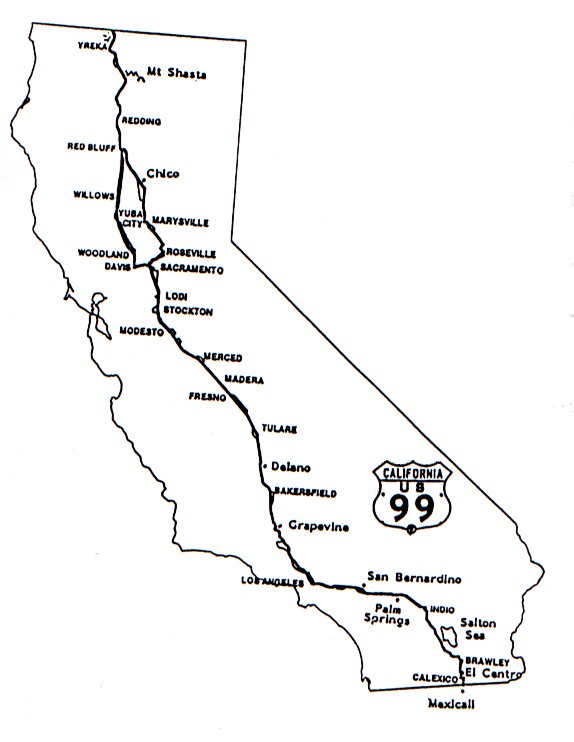
US 99 ran through the heart of California. It entered the state from Oregon near Siskiyou Summit and left the state (and country) at Calexico. In between, it ran on the following course:
Pacific Highway Section
Hornbrook, Yreka, Weed, Mt. Shasta City, Dunsmuir, Redding (Crossing US 299), Red Bluff
At Red Bluff, US 99 split into US 99E and US 99W.
- US 99E’s route (Following current SR-36, SR-99, SR-20, SR-70, SR-65, I-80):
- Los Molinos, Chico, Yuba City, Marysville, Lincoln, Roseville, Sacramento
- US 99W’s route (Following current I-5, SR-113, I-80):
- Corning, Maxwell, Arbuckle, Woodland, Davis, Sacramento
The routes rejoined in downtown Sacramento. US 50 also joined. From there, US 99 followed this routing:
Golden State Highway Section
Sacramento, Stockton (US 50 leaves), Modesto, Madera, Fresno, Tulare, Delano, Famoso (US 466 joins), Bakersfield (US 466 leaves, US 399 joins), Greenfield (US 399 leaves), Lebec, Gorman, Castaic, Santa Clarita, Los Angeles
In Los Angeles, Former US 99 leaves I-5, joins I-10 (Former US 60 and US 70), and goes through:
El Monte, West Covina, Pomona (US 60 leaves), Ontario, Colton, Redlands, Beaumont (US 60 rejoins), Banning, Indio
In Indio, former US 99 leaves I-10 (former US 60/US 70) to follow SR-86:
Valerie Jean, Oasis, Salton City, Kane Springs, Westmorland, Brawley, Imperial, El Centro (Joining US 80 for a few blocks), Heber, Calexico.
At Calexico, US 99 left SR-86 to follow SR-111:
Heading south on current SR-111, US 99 ended at the border in Calexico at 1st St and Heffernan Ave.
Thus was the routing of US 99 through the State of California.


US 99 Ends


Southern End of US 99
The southern end of US Highway 99 changed a few times during its history. From 1926 to 1931, the route ended in El Centro at the junction with US 80 at Imperial Ave and Adams Ave. In 1931, the route was extended to Calexico, where it terminated until 1964. In 1964, the south end moved to Los Angeles briefly. By 1968, US 99 was completely removed from California, putting the southern terminus in Oregon near Ashland, OR.
Signs along US 99


The mileposts used today by Caltrans were were placed along the highways in 1964. That mileage, as of July 1, 1964, became the “base” mileage. Any changes after that date became “R” or realignment mileage. US 99, between Los Angeles and Wheeler Ridge, became Route 5. Mileposts reflected this change and were posted along the entire route. Some of those mileposts remain today along sections of old US 99.


Brief history of the highway from Los Angeles to Bakersfield
Originally commissioned in 1926, it wouldn’t be signed in California until 1928. The first highway along the routing of what was to become US 99 was the Ridge Route. It was completed over Newhall Pass in 1910 and over Tejon Pass in 1915.

In 1930, a three lane highway, the Newhall Alternate, was built through Weldon and Gavin Canyons bypassing Newhall and Saugus entirely. This new route was shorter and less steep. It also avoided the Newhall Tunnel. Early in 1931, construction began on a three lane highway over the Liebre Mountains which lie just north of Castaic. This was to bypass the treacherous curves and grades over the Ridge Route. Finally on October 29, 1933, US 99 was opened over the Liebre Mountains with three lanes. It was known as the Ridge Route Alternate. By 1936, all of the old Ridge Route had been replaced over the mountains.
Traffic increased so much over the highway that in 1940 plans were made to widen the highway to four lanes. These plans were delayed until 1947 because of WWII. Below there is a list of most of the changes made to the highway from Newhall Pass to Tejon Pass. List runs from south to north. Most of this widening work was completed by 1952.
| Section: | Length: | Cost: | Date Completed: |
| Pico Road (Lyons Avenue) to Saugus Road (Saugus Junction) | 3.3 miles | $450,000 | 4-8-1949 |
| Santa Clara River to Castaic Creek | 2.6 miles | $489,000 | 5-13-1949 |
| Palominos Creek to Violin Summit (Five Mile Grade) | 2.6 miles | $795,000 | 6-9-1948 |
| Violin Summit to Whitaker Summit | 4.4 miles | $1,392,000 | 2-24-1949 |
| Whitaker Summit to Piru Creek (Three Mile Grade) | 3.8 miles | $1,420,000 | 10-8-1948 |
| Los Alamos Creek to 2.3 miles S of SR-138 (at the Gorman Post Road / I-5 junction) | 6.7 miles | $967,000 | 12-8-1949 |
In 1954, the first portion of US 99 north of Los Angeles became a freeway. It ran from the SR-7, US 6, and US 99 interchange (now I-5 / I-210) to just beyond the US 6 / US 99 junction (now SR-14 / I-5). A three level interchange was built at the US 6 / US 99 interchange. This routing is now used by the truck routes of I-5.
Slowly, section by section US 99 was being replaced by I-5. In remained a signed US route until 1968. By 1970, almost all of old US 99 had been replaced by I-5 and I-10 in California. The last section to be replaced was in the Sacramento River Canyon, near Gibson between Lake Shasta and Dunsmuir in 1991.
Why is it called “The Grapevine”?

I-5 is commonly referred to as “The Grapevine” by locals and traffic reporters. Most assume the name derives from the twisty nature of the original roadway – the Ridge Route. That road was indeed very twisty, much like a grapevine. However, that is still not the reason. The name Grapevine actually comes from Grapevine Canyon, where old US 99 and I-5 come down from the mountains and into the San Joaquin Valley. The canyon is called such as wild grapes grow along the canyon walls. It was formerly known as Canada De Las Uvas which is Spanish for Canyon of the Grapes. The name Tejon Pass is also a “new” addition to the area. The current Tejon Pass was known as Grapevine Pass or Badger Pass until the 1850’s. Old Tejon Pass, much farther to the east, was a very treacherous route. That pass was eventually abandoned in favor of the current Tejon Pass. The name was just shifted to the new route.
After the 1933 bypass of the original road to as late as the 1970’s, the roadway over the mountains was still referred to as “The Ridge Route”. It wasn’t until the 1980’s that the name “The Grapevine” was extended to the entire roadway. Why this was done is still unclear. Even Caltrans called it the “Ridge Route”. So, if you want to call it proper – call it Tejon Pass, when being specific to the actual pass, and the Ridge Route when referring to I-5 from Castaic to Grapevine. While you’re passing through Grapevine Canyon, be sure to spot the wild grapevines that still grow in the canyon. Names may change, but the name Ridge Route should live on. It applies to I-5 better than “The Grapevine” ever will.
Pyramid Dam and Reservoir

Pyramid Dam was completed in 1970 and is a part of the California State Water Project or Feather River Project. The dam and reservoir are named after Pyramid Rock, paying a small homage to the roadway the dam and reservoir submerged under water. Pyramid Rock was created in 1932 when a section of the Ridge Route Alternate cut through a meander in Piru Creek. This cut left a pyramid-shaped rock to the west side, hence the name. The rock stands today, as shown in the photograph above, in front of Pyramid Dam. There are, however, two other features that are often confused to be the source of the name. The cut on the west side of the dam and the island near the dam are both pyramid shaped.
The Pine and the Palm

Just north of Fresno, 1.75 miles south of Ave 12, and 2.1 miles north of Ave 9 (or more specifically at 06-MAD-99-05.7), there lies a pine tree and a palm tree in the median of Highway 99. It has been there for many years and marks the former halfway point along US 99 in California. The Palm Tree, a Canary Island Date Palm, represents Southern California and the Pine Tree, a Deodor Cedar, represents Northern California. A few years ago, the pine tree fell down but was replaced by Caltrans as this is a somewhat historic marker.
There is currently a project to place signs at this historic location by the Historic Highway 99 Association of California. For more information, please contact them using the link below.
https://historic99.org/the-pine-and-the-palm/
Photos and Videos of US 99 in Southern California


US 99 Museums, Books, and Links
- Historic Highway 99 Association of California
- Ridgeroute.com by Harrison Scott Information about the Ridge Route and books available
- Ridge Route Preservation Organization
- Finding US 99 by Casey Cooper
- California Highways by Alps Roads
- Historic Pacific Highway in Washington
- Bygone Byways
- Ends of US 99 and other US Highways
- Historic US Highways by Michael Herman
Books:
- Pictorial History of Highway 99: The Scenic Route by Carole Steele
- Living Gold Press – “That Ribbon of Highway” series
Special Sections
- US 99 in Shasta Lake, CA
- June 2021 Presentation on Lake Shasta
- US 99 – Tipton, CA to Tulare, CA
- US 99 in Alhambra, CA
- US 99 in Colton, CA
- US 99 near Redlands, CA
- US 99 in Indio, CA
- US 99 – Edom to Calimesa – Part 1
- US 99 – Edom to Calimesa – Part 2

Interesting site. Is there a map of the Interstate Highway System (nationwide or just CA) that includes the date of completion for each segment of the system?
I’m looking for a waterfall and the exit for it. It’s a short path not far off the hwy, somewhere between Los Angeles and Delano. We used to stop there often approximately 25 years ago.
I am currently working in the San Bernardino county archive and there are documents from 1934 showing the State of California wanting to buy some land of a recently deceased woman in order to create highway 99. I thought it was so fascinating! Just thought I would share. Very informative site!
There still was one sign of US 99 in Oregon as of a few years ago. Alas, the overhead US 99 sign in Roseburg was removed when a revamping of I-5 was undertaken about 10 years ago.
There was (or may still be) an additional original US 99 shield in Seattle, WA at 1st and Columbia St at the Alaskan Way Viaduct.